
This Home Sale Tax Rule Started in 1997 and Never Changed. Here Is Why That Matters
In our first post on capital gains tax, we explained the big break that lets home sellers keep a lot of their profit tax free. Now here is the part that surprises almost everyone. The size of that break, $250,000 for singles and $500,000 for married couples, was set way back in 1997. It has not changed since. Not once. That is a big deal, and it gets bigger every year.
Where This Rule Came From
Back in 1997, Congress passed a law called the Taxpayer Relief Act. According to the National Association of REALTORS, this law created the home sale exclusion we use today.
Here is what changed in 1997, kept simple:
Before then, the rules were clunky. You often had to buy another home to avoid the tax.
There was also a one time break for sellers over age 55.
The 1997 law swept that away and gave us the clean $250,000 and $500,000 limits instead.
At the time, those numbers felt huge. Hardly anyone expected a regular family home to make that much profit. So lawmakers figured the limits were more than enough.
The Problem Nobody Fixed
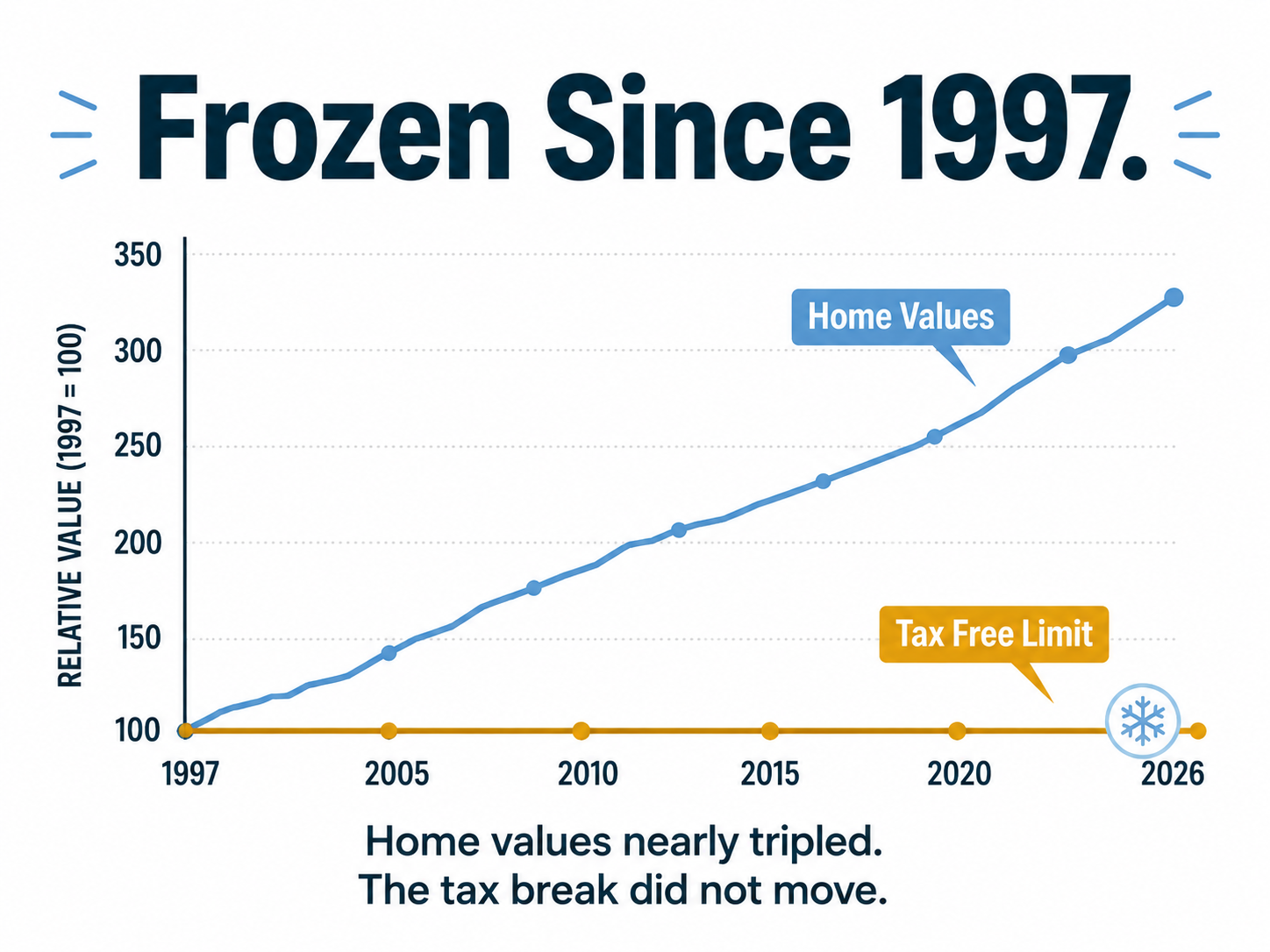
Here is the catch. Most tax numbers get adjusted for inflation over time, which means they grow a little each year to keep up with rising prices. The home sale exclusion never got that treatment. It was frozen in place.
Think about how much has changed since 1997:
Prices on almost everything have roughly doubled.
Home values across the country have nearly tripled.
That $250,000 and $500,000 break has stayed exactly the same the whole time.
Experts point out that if the limits had simply kept up with inflation, they would be far higher today, somewhere around $500,000 for singles and close to $1 million for married couples. Instead, the break covers less and less of your real profit every year.
What This Means for Longtime Owners Here
This is where it hits home in the western suburbs. We work with a lot of sellers who bought their Naperville or Aurora home decades ago. They raised their kids there. They paid it down. And their home is now worth a fortune more than they paid.
That is wonderful. But because the tax break never grew, some longtime owners get nervous that selling will trigger a tax bill. There is even a name for what happens next. It is called the lock in effect. People stay put because they are scared of the tax hit, even when the home no longer fits their life. That keeps good homes off the market, which is part of why inventory is so tight around here.
We see this pattern often. Sellers who have owned a home for 30 years come to us worried sick about taxes, and the first thing we do is help them understand the real numbers before they make any decision. Many of them come back to us years later to thank us, and a lot send us their friends and family. You can see our review on Google.
You Have Options, and You Have a Team
The frozen rule is frustrating, but it does not have to trap you. Through Baird & Warner, we have the tools and the network to help you understand your equity, your likely profit, and your timing. Vickie and the rest of our team do this every week.
And to be clear, we are agents, not accountants. We always tell our sellers to confirm the exact tax numbers with a CPA. Our job is to make sure you walk in with a plan instead of a fear.
Up next, we do the actual math step by step so you can estimate your own situation. Read Will You Owe Capital Gains Tax on Your Illinois Home Sale? And if you have heard talk of the rule changing, we sort fact from hope in Could Capital Gains Tax on Home Sales Go Away?
Frequently Asked Questions
When did the capital gains home sale exclusion start?
It started in 1997 with the Taxpayer Relief Act. The limits were set at $250,000 for single sellers and $500,000 for married couples, and they have not been raised since.
Why has the home sale tax break never gone up?
Because it was never tied to inflation. Most tax figures rise a little each year to keep pace with prices, but this one was frozen. So even though home values have climbed for nearly 30 years, the break has stayed the same.
Is there a capital gains expert near me who knows the western suburbs market?
We are a local team serving Naperville, Aurora, Oswego, and Plainfield, and we talk through equity and taxes with every seller before they list. We do not give tax advice, but we make sure you know your numbers and have the right pros in your corner.
If you have owned your home a long time and the tax question is the only thing holding you back, let us help you see the real picture. A short conversation now can replace a lot of worry. Reach out anytime.
Ready to make your next move in the western suburbs of Chicago?
We are here to help you every step of the way, whether you are buying, selling, or just exploring your options.
Julia Corkey & Vickie Schoenfeld
Team Elite Realtors at Baird & Warner
630-286-9777 | [email protected] | www.homesbyteamelite.com
Book a Consultation | Get Your Home Value | Search Homes on Zenlist
Follow us: Facebook | Instagram | YouTube
Licensed REALTORS proudly serving Naperville, Aurora, Oswego, Plainfield and the Western Chicago Suburbs