
Will You Owe Capital Gains Tax on Your Illinois Home Sale? Let Us Do the Math
By now you know the basics from our first post and why the rule is stuck in 1997. Now for the part everybody really wants. The math. When sellers have real equity, the first question is always the same. "How much is the tax man going to take?" So let us walk through it slowly, in small steps, with simple numbers. We are agents and not accountants, so use this to get your bearings and then confirm the real figures with a CPA.
Step by Step: How to Estimate Your Gain
You do not need to be good at math for this. Just follow the steps in order.
Step 1. Find your cost basis. This is what you paid for the home, plus the money you spent on big improvements. New roof, new kitchen, a room addition. Repairs like fixing a leaky faucet do not count.
Step 2. Find your net sale price. Take what you sell for, then subtract your selling costs, like the agent commission and certain closing fees.
Step 3. Find your gain. Subtract your cost basis from your net sale price. That number is your profit.
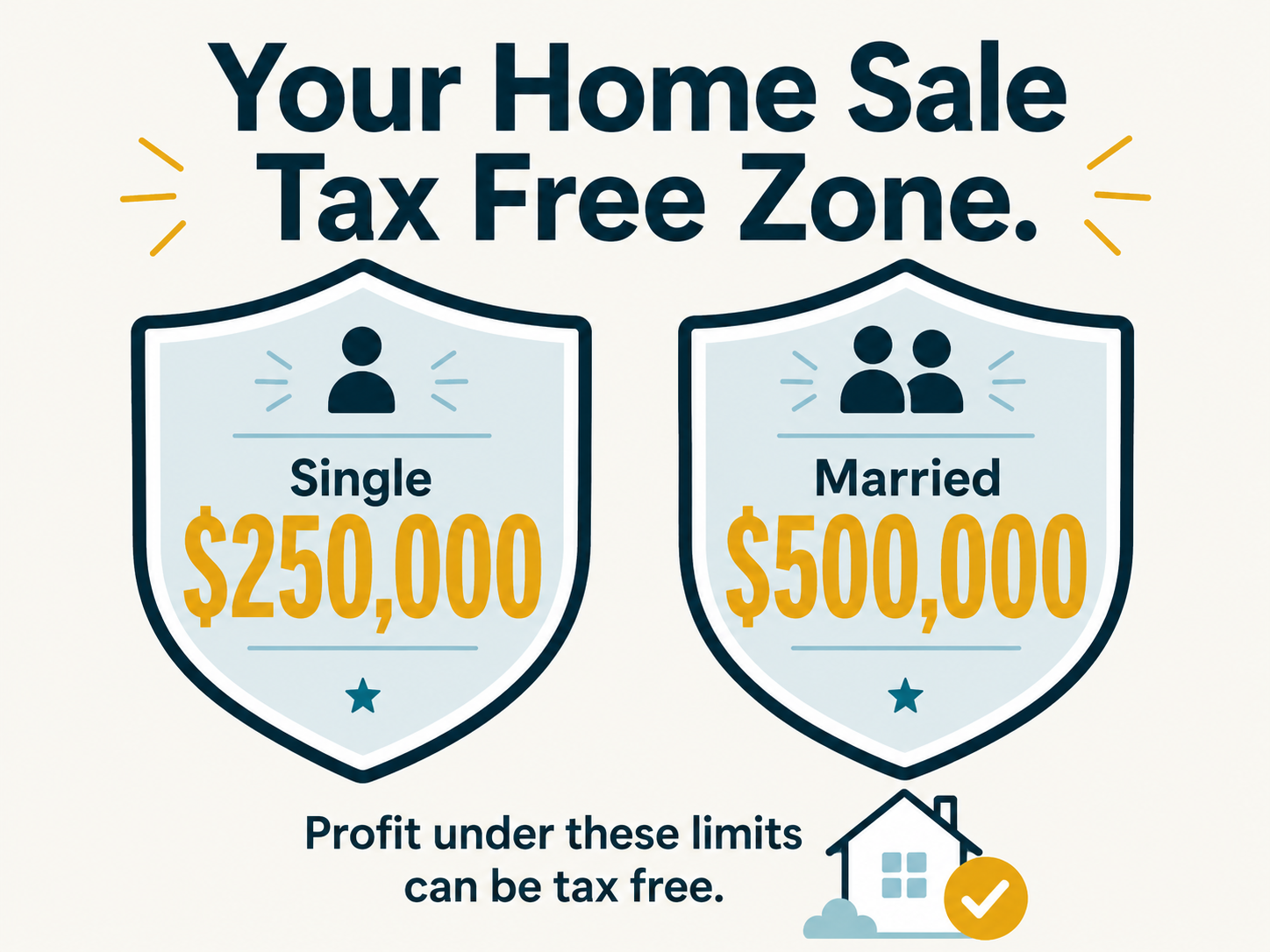
Step 4. Subtract your exclusion. Take off $250,000 if you are single, or $500,000 if you are married filing together.
Step 5. Whatever is left is taxable. If the answer is zero or less, you owe no federal capital gains tax.
That is the whole process. Keep your receipts for improvements, because they raise your basis and shrink your gain. That is one of the easiest ways to lower your number.
Example One: No Tax Owed
Let us use a simple, common case.
A married couple bought their home for $300,000.
They added $50,000 in improvements over the years. Cost basis is now $350,000.
They sell for $750,000 and pay $50,000 in selling costs. Net sale price is $700,000.
Gain is $700,000 minus $350,000, which is $350,000.
They are married, so they subtract the $500,000 exclusion.
$350,000 is less than $500,000, so their taxable gain is zero.
This couple owes no federal capital gains tax. This is how it plays out for most sellers, and it is the relief we get to deliver in a lot of seller meetings.
Example Two: Some Tax Owed, Plus the Illinois Piece
Now a longtime owner with a lot of equity.
A married couple bought in 1999 for $200,000.
Over 25 years they spent $100,000 on a new kitchen, roof, and an addition. Cost basis is $300,000.
They sell for $950,000 and pay $60,000 in selling costs. Net sale price is $890,000.
Gain is $890,000 minus $300,000, which is $590,000.
They subtract the $500,000 married exclusion. Taxable gain is $90,000.
Now the tax on that $90,000. There are two parts.
Federal. Most sellers who owe land in the 15 percent long term bracket. On $90,000, that is about $13,500. Lower earners can pay 0 percent. High earners can pay 20 percent and a small extra surtax.
Illinois. Here is the part most people forget. Illinois taxes the gain like regular income at a flat 4.95 percent. On $90,000, that is about $4,455.
So in this example, the total is roughly $17,955. Not nothing, but a long way from the scary number this couple feared, and only on the slice above the exclusion. The other $500,000 of profit is theirs, tax free.
Why We Run These Numbers With You Early
The reason we walk sellers through this before listing is simple. Surprises at the closing table are the worst kind. When you see the math early, you can plan for it, price for it, and keep your receipts so your basis is as high as it should be.
On every home we evaluate, we use a tool called RealReports that pulls data from more than 30 sources, including sale history and improvement records. It helps us give you a clear, honest starting point instead of a guess. Our sellers tell us this kind of preparation is the most thorough they have seen, and you can read their words in our Baird & Warner reviews.
One more time, because it matters. These examples are general. Your real numbers depend on your records and your income, so confirm everything with a CPA or tax pro before you make a move.
Curious whether changes to this tax are coming? We break down the latest in Could Capital Gains Tax on Home Sales Go Away?
Frequently Asked Questions
How do I figure out capital gains tax on my home in Illinois?
Start with your profit, which is your net sale price minus your cost basis. Subtract your $250,000 or $500,000 exclusion. Tax only applies to what is left, at a federal rate plus Illinois at 4.95 percent. Always confirm the exact figures with a tax pro.
Does Illinois charge its own capital gains tax on a home sale?
Yes, if you have a taxable gain after the federal exclusion. Illinois treats it like regular income and taxes it at a flat 4.95 percent. There is no separate lower rate for long term gains at the state level.
Who can help me run my home sale numbers near me before I list?
We help sellers across Naperville, Aurora, Oswego, and Plainfield estimate their equity and likely gain before listing, then point them to a trusted tax pro to confirm. It is a normal part of every listing conversation we have.
Want to see your own numbers instead of guessing? Get your home value here, then let us sit down and map it out together. No pressure, just clarity.
Ready to make your next move in the western suburbs of Chicago?
We are here to help you every step of the way, whether you are buying, selling, or just exploring your options.
Julia Corkey & Vickie Schoenfeld
Team Elite Realtors at Baird & Warner
630-286-9777 | [email protected] | www.homesbyteamelite.com
Book a Consultation | Get Your Home Value | Search Homes on Zenlist
Follow us: Facebook | Instagram | YouTube
Licensed REALTORS proudly serving Naperville, Aurora, Oswego, Plainfield and the Western Chicago Suburbs